
Concert Program
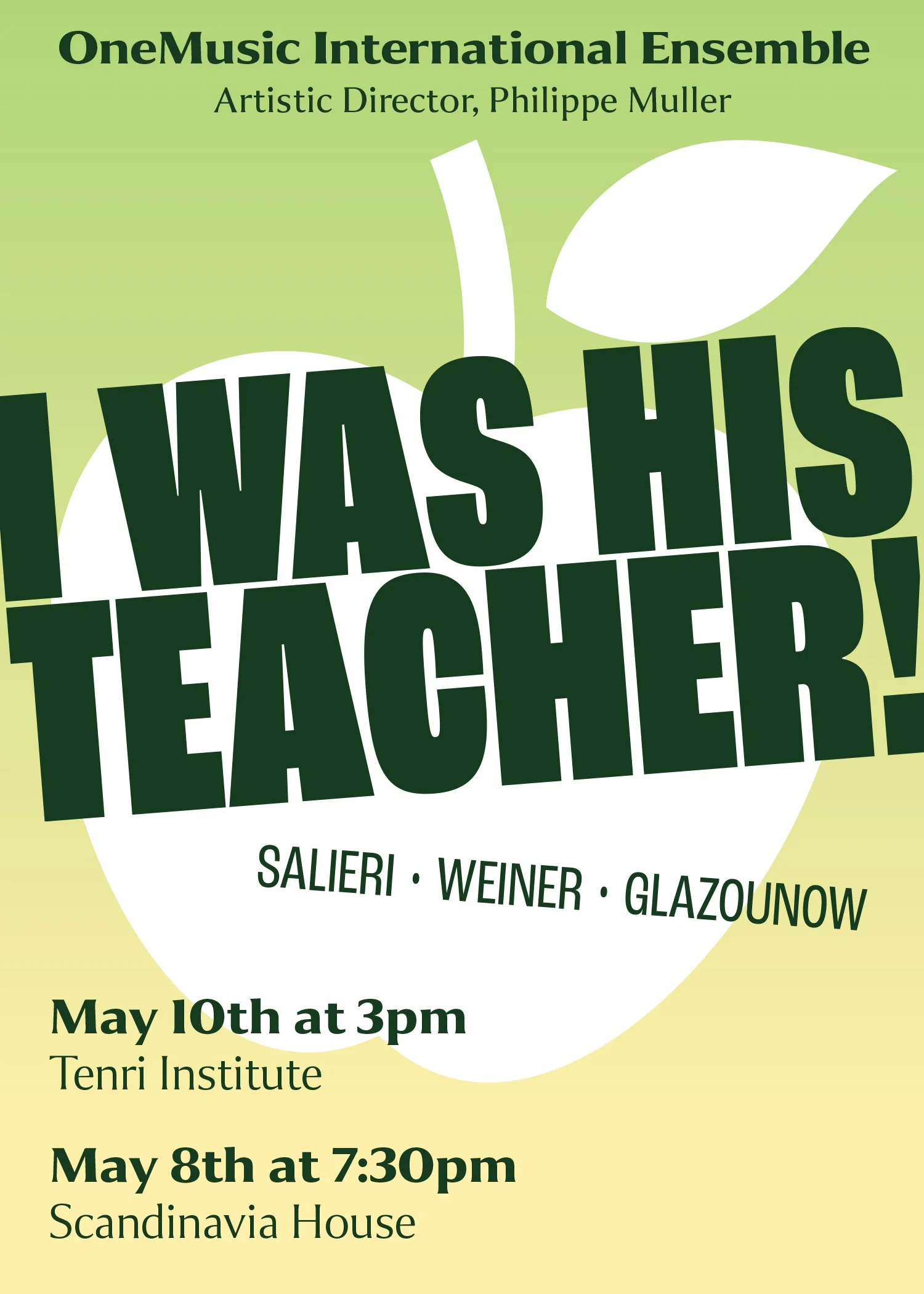
OneMusic International Ensemble
I Was His Teacher
May 8 & 10, 2026
Yibin Li, Leerone Hakami - violins
Danniel Panner - viola
Philippe Muller - cello
Samuel Adams - reading
Fugue for String Quartet
Antonio Salieri (1750-1825)
String Trio in G Minor, Op. 6
Leo Weiner (1885-1960)
I. Allegro con brio
II. Vivace
III. Andantino
IV. Allegro con fuoco
Intermission
String Quartet in D Minor Op.70
Alexandre Glazounow (1865-1936)
I. Andante
II. Allegretto
III. Adagio con licenza
IV. Allegro
The Artists

Yibin Li
Yibin Li was born in Jiuquan, China, a small city near the Gobi Desert. When she was just 4 1/2, she began playing the violin under the guidance of her father. Just 7 years later, she left home to study at Xi’an Conservatory, where she remained until moving on to Shanghai Conservatory. Upon her graduation, she was appointed to the violin faculty, and taught in Shanghai for six years as a young member of the tenured faculty. At 25, she felt the need to continue her studies in the US and moved to New York, where she went on to earn two additional graduate degrees at The Juilliard School and Mannes School of Music. Her teachers have included Lewis Kaplan, Seymour Lipkin, Earl Carlyss, Peiwen Yuan and Xiaolong Liu.
Ms. Li has performed as a soloist with major symphonies in China and the US, including the Beijing National Symphony Orchestra, Shanghai Symphony Orchestra, Taipei Symphony Orchestra, Gaoxiong Symphony Orchestra, San Diego Symphony, Hunter Symphony and Syracuse Symphony Orchestra. She was the first violinist and founder of the Iris String Quartet, and the founder of French-American Ensemble, and has directed and played chamber music concerts in many New York City venues including Carnegie Hall, Alice Tully Hall, Merkin Hall and Scandinavia House. In China, she traveled to over 20 cities performing both solo and chamber concerts in major performing arts centers.
Ms. Li performs and teaches regularly at summer music festivals including the Bowdoin International Music Festival and Bach Virtuoso Festival in Maine., MusicAlp International Academe, LaSalle Music Festival in France, Sesto Rocchi Chamber Music Festival in Italy and the Lake Lugano Chamber Music Festival in Switzerland.
Yibin Li is currently on the faculties of Mannes School of Music and The Juilliard School Pre-College Division, and is a visiting professor in China at the Xi’an Conservatory of Music and Beijing Central University for Normal Studies.
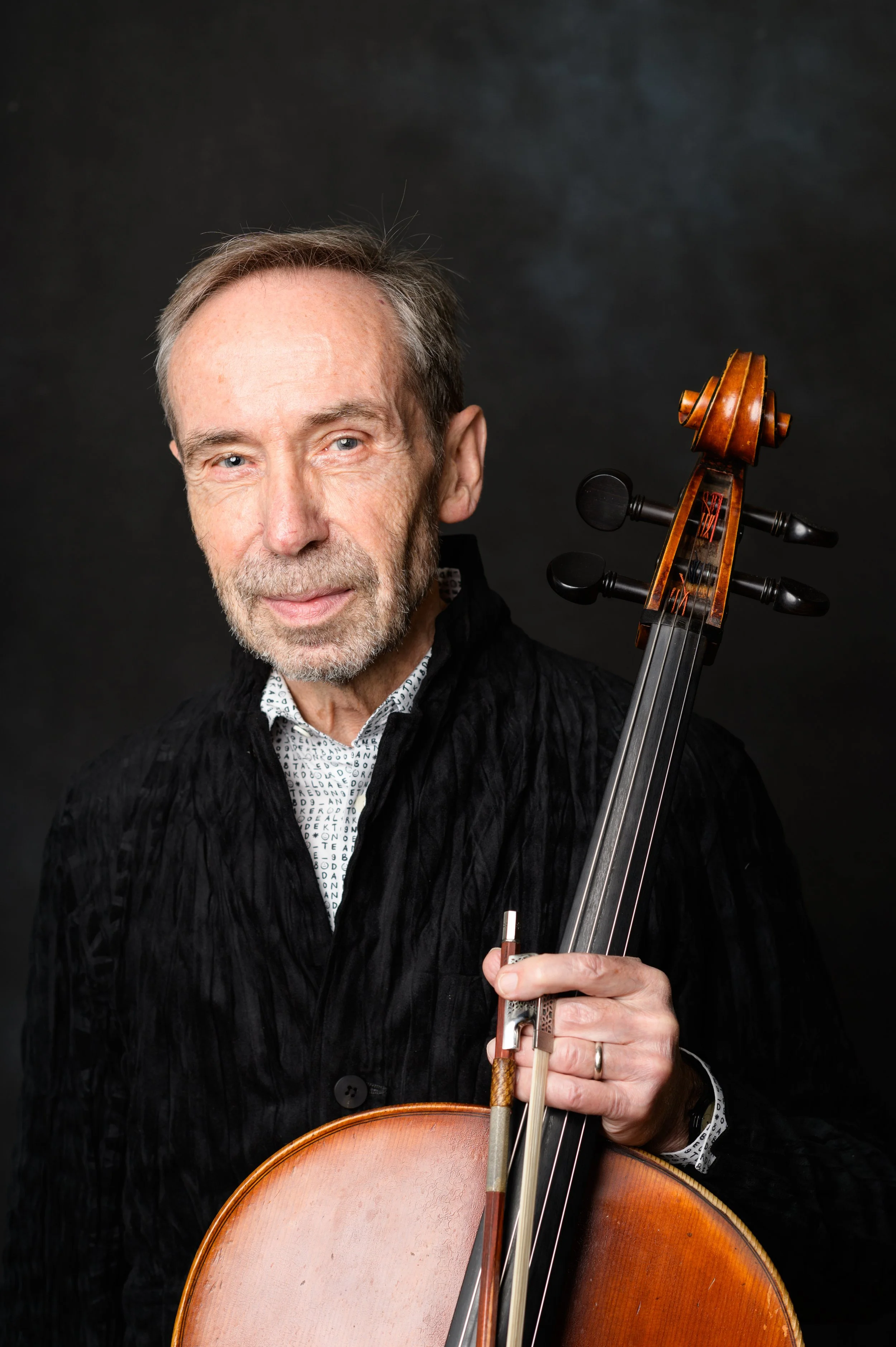
Philippe Muller
Born in Alsace, Philippe Muller was raised in both the French and German musical traditions that characterize that province. His early experiences opened his mind to varying cultures and lead him to a multi-faceted career. He performs and has recorded a wide range of repertoire, from the Bach Suites, through the music of living composers.
In 1970, Mr. Muller founded a Piano Trio with pianist Jacques Rouvier and Jean- Jacques Kantorow, violin, which was widely known to be one of Europe’s most venerated chamber music ensembles. He worked closely with Pierre Boulez’ Ensemble Intercontemporain, for seven years, giving him an understanding of and an affinity for the music of our time. He continues to be active in commissioning new cello works and premiers of new music and performs frequently as soloist and in various chamber music ensembles at festivals in Europe, the United States, Canada, Latin America, Japan, Korea, Australia and New Zealand.
Philippe Muller’s teaching career is legendary. He succeeded his mentor André Navarra as cello teacher at the Conservatoire de Paris in 1979, continues his teaching legacy today here in New York, at the Manhattan School of Music. Many cellists from his studio have gone on to major careers as soloists including Xavier Phillips and Gautier Capuçon. He travels often giving master-classes in the top conservatories across the globe and has spent twenty years teaching at the Academy of French Music in Kyoto, Japan.
Philippe Muller frequently serves on the juries of the major international cello competitions such as the Tchaikovsky in Moscow, Paulo in Helsinki and Rostropovitch in Paris.
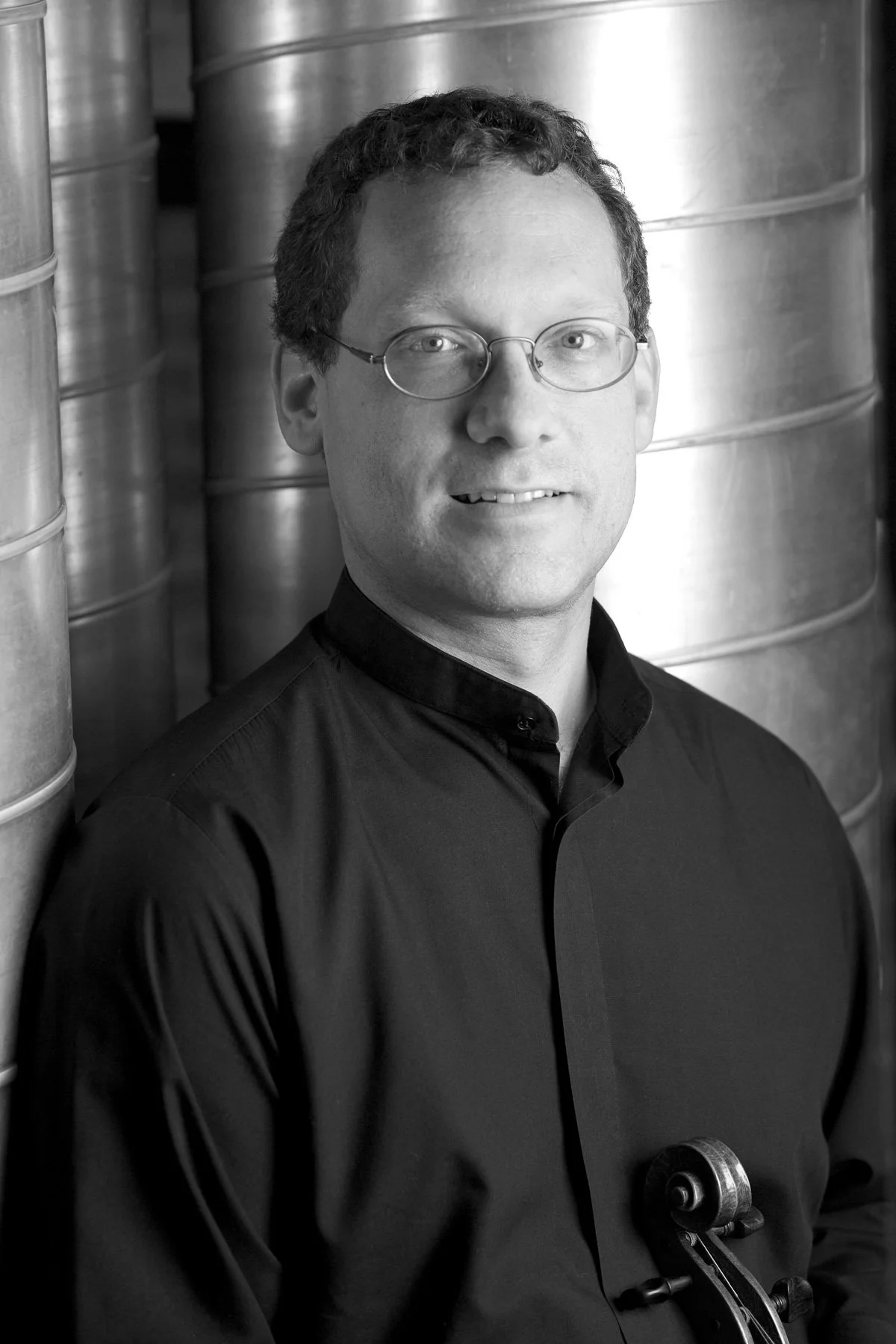
Daniel-Panner
Daniel Panner enjoys a varied career as a performer and teacher. As violist of the Mendelssohn String Quartet, he concertized extensively throughout the United States and Israel. He has performed at numerous music festivals, including Marlboro, Ravinia, Tanglewood and Aspen, and he has collaborated with members of the Cleveland, Emerson, Guarneri and Juilliard String Quartets. As a member of the Whitman String Quartet, Mr. Panner received the 1998 Walter W. Naumburg Chamber Music Award and served as a teaching assistant to the Juilliard String Quartet for two years.
Mr. Panner is co-chair of the string department of the Mannes College of Music, where he also teaches viola and chamber music. He has also taught at the Juilliard School, Rutgers University, SUNY Stonybrook, Queens College, and the Jerusalem Music Center Summer Courses, and he has given master classes at such schools as Peabody, Hartt and the North Carolina School of the Arts. He has performed with the Chamber Music Society of Lincoln Center, the Metropolitan Opera Orchestra, the New York Philharmonic, and the Orchestra of St. Lukes; he has also toured with Musicians from Marlboro and the Orpheus Chamber Orchestra. As a guest artist, he has performed with the Juilliard String Quartet, the St. Lawrence String Quartet, the Daedelus String Quartet, the Flux String Quartet and the Moscow Conservatory Trio. Mr. Panner has been heard on National Public Radio's "Performance Today," both as a soloist and chamber musician. He has served as the principal violist of such orchestras as the New York City Opera and the Mostly Mozart Festival Orchestra. An active performer of new music, he is a member of Sequitur and the Locrian Ensemble and has performed as guest with such new-music groups as Speculum Musicae, the Da Capo Chamber Players, and Transit Circle; he has recorded solo viola works by Thea Musgrave and Victoria Bond, both for Albany Records. Mr. Panner studied with Jesse Levine at Yale University, where he earned a bachelor's degree in history. He continued his studies at the Curtis Institute of Music with Joseph dePasquale and the Juilliard School with Samuel Rhodes.
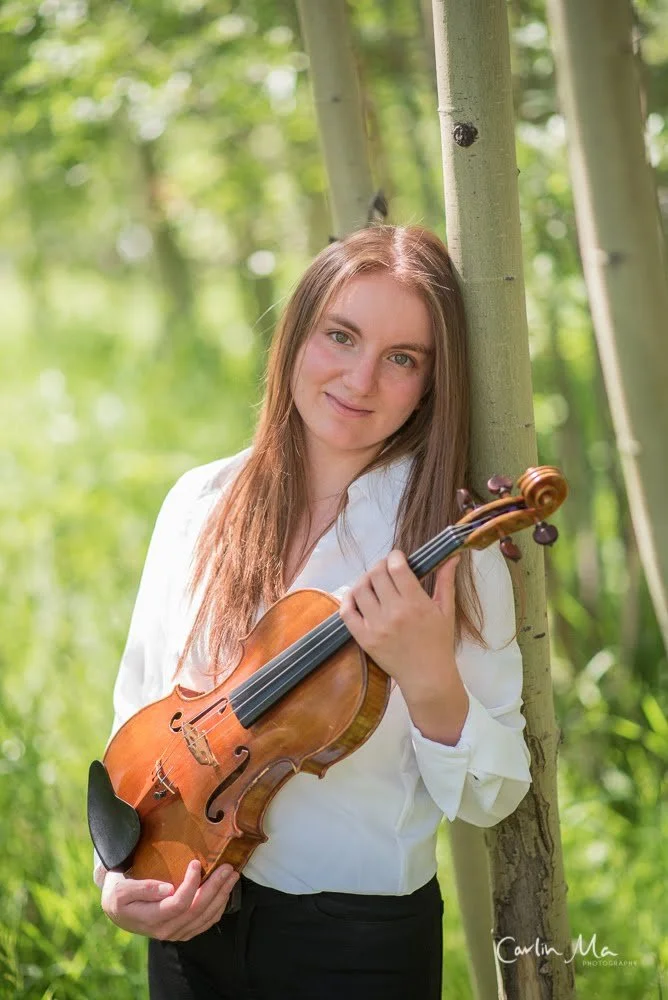
Leerone Hakami
Leerone Hakami is an Israeli-American violinist whose performances have taken her to concert halls and festivals across North America, Europe, and Israel. She earned both her Bachelor’s and Master’s degrees in violin performance from The Juilliard School, studying with renowned pedagogue Lewis Kaplan. While at Juilliard, she served as a Morse Teaching Fellow in the Pre-College Division and was awarded an Entrepreneurial Grant to lead a summer music workshop on the Navajo Reservation in New Mexico.
Leerone has appeared as a soloist with the New York Concerti Sinfonietta at Carnegie Hall’s Weill Recital Hall and with the Vermont Mozart Festival Orchestra. As an active chamber musician, she has performed at Alice Tully Hall in Lincoln Center. She is the Grand Prize winner of the Artists International Competition and was recently featured on New York’s classical music radio as a First Prize winner of the Prix Ravel.
In addition to her performing career, Leerone is the co-founder of West Amadeus Music Studio, a leading provider of private music instruction in New York City. She also performs regularly with Concerts in Motion, sharing live classical music with audiences who would otherwise be unable to attend concerts.
Leerone frequently collaborates with her husband, pianist Shay
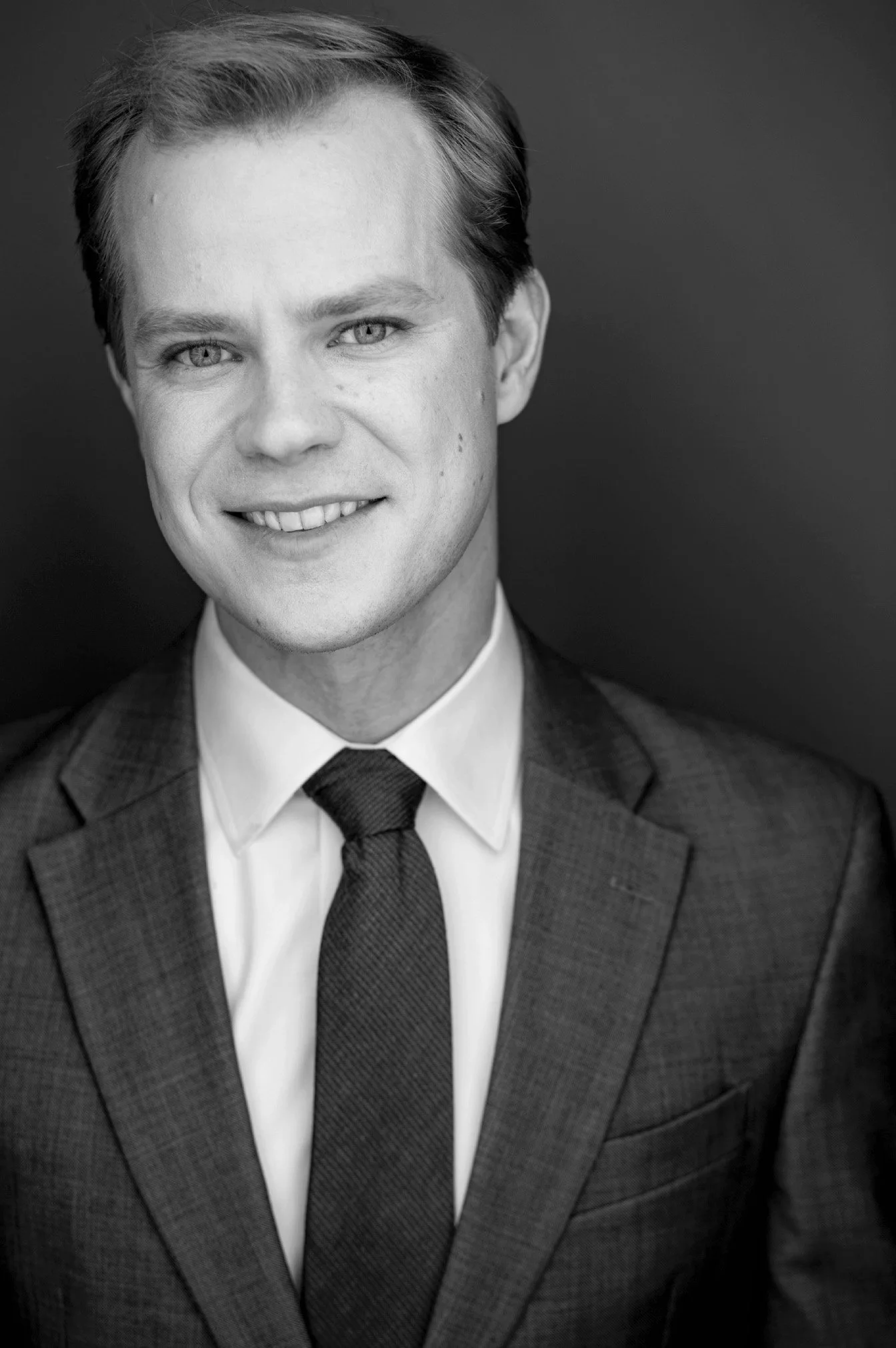
Samuel Adams
Samuel Adams is an NYC-based actor, director, and educator. Although a third-generation native of New York City, Sam was raised in a small farm-town upstate. He received his undergraduate education from the London Dramatic Academy and Adelphi University and his graduate degree from the George Washington University in collaboration with the Shakespeare Theater Company. He has worked as a director and an actor in films, television, and theaters across the nation, recently playing Mozart in Peter Schaffer’s celebrated play Amadeus at Folger Shakespeare Theatre and the titular character in Shakespeare's Henry V in at the Chesapeake Shakespeare Company. In addition to these pursuits, he has worked extensively as a teacher, arts-administrator, and gardener. Visit him on Youtube and Instagram at @TheUnweededGarden.
Program Notes
Clara Josephine Wieck Schumann (1819–1896),Three Romances for Violin and Piano, Op. 22
In the last few years of Robert Schumann's life, as the Düsseldorf situation and his health - physical and mental, deteriorated together. Robert attempted suicide in 1854 and spent the last two and a half years of his life in a sanatorium in Endenich, a suburb of Bonn. Clara was only allowed, on his doctors’ orders, to see him during his final days, when it became clear that he was dying.
1853, however, had been a relatively good year for both, musically productive and culminating in an inspiring month-long visit from the 20-year-old Brahms. Clara herself began to compose that summer, the Three Romances, Op. 22, were among the last pieces that Clara ever wrote. After Robert’s death, she composed almost nothing more herself, instead keeping Robert’s music alive through her touring and editing.
The romance was one of Clara’s favorite character genres, tender, passionate, and deeply personal.
The Andante molto has hints of gypsy pathos amid lyrically supple sentiments, and the spirits of the Allegretto have a darker center. Almost as long as the other two together, Clara’s final romance, marked Leidenschaftlich schnell (passionately quick), features a long-limbed melody over rippling pianism, developed with assurance.
Franz Liszt (1811–1886) Three French Songs (texts by Victor Hugo) for Soprano and Piano
Franz Liszt set three poems by the great French writer Victor Hugo, and the result is music of extraordinary sensuality and longing. Hugo's poetry already burned with romantic intensity; Liszt's settings take that flame and give it wings. In S'il est un charmant gazon, Comment, disaient-ils, and Oh! Quand je dors, we hear Liszt at his most tender - not the thundering virtuoso of the concert hall, but a composer completely in the service of love.
S’il est un charmant gazon
Victor Hugo
S’il est un charmant gazon
Que le ciel arrose,
Où brille en toute saison
Quelque fleur éclose,
Où l’on cueille à pleine main
Lys, chèvrefeuille et jasmin,
J’en veux faire le chemin
Où ton pied se pose!
S’il est un rêve d’amour,
Parfumé de rose,
Où l’on trouve chaque jour
Quelque douce chose,
Un rêve que Dieu bénit,
Où l’âme à l’âme s’unit,
Oh! j’en veux faire le nid
Où ton cœur se pose!
If there be a lovely lawn
If there be a lovely lawn
Watered by the sky,
Where each new season
Blossoming flowers spring up,
Where lily, woodbine, and jasmine
Can be gathered liberally,
I would strew the way with them
For your feet to tread!
If there be a dream of love
With the scent of roses
Where each day may be found
Some sweet new delight,
A dream blessed by the Lord
Where soul unites with soul,
Oh! I shall make of it the nest
Where your heart will rest!
English translation © Richard Stokes
Comment disaient-ils
Victor Hugo
Comment, disaient-ils,
Avec nos nacelles,
Fuir les alguazils?
Ramez, disaient-elles.
Oublier querelles,
Misère et périls?
Dormez, disaient-elles.
Comment, disaient-ils,
Enchanter les belles
Sans filtres subtils?
Aimez, disaient-elles.
How, said the men,
in our small craft
can we flee the alguazils?
– Row, said the women.
How, said the men,
can we forget feuds,
poverty and peril?
Sleep, said the women.
How, said the men,
can we bewitch the fair
without rare potions
Love, said the women.
Oh! Quand je dors
Victor Hugo
Oh! quand je dors, viens auprès de ma couche,
Comme à Pétrarque apparaissait Laura,
Et qu’en passant ton haleine me touche …
Soudain ma bouche
S’entr’ouvrira!
Sur mon front morne où peut-être s’achève
Un songe noir qui trop longtemps dura,
Que ton regard comme un astre se lève …
Et soudain mon rêve
Rayonnera!
Puis sur ma lèvre où voltige une flamme,
Éclair d’amour que Dieu même épura,
Pose un baiser, et d’ange deviens femme …
Soudain mon âme
S’éveillera!
Ah, while I sleep
Ah, while I sleep, come close to where I lie,
As Laura once appeared to Petrarch,
And let your breath in passing touch me …
At once my lips
Will part!
On my sombre brow, where a dismal dream
That lasted too long now perhaps is ending,
Let your countenance rise like a star …
At once my dream
Will shine!
Then on my lips, where a flame flickers -
A flash of love which God himself has purified -
Place a kiss and be transformed from angel into woman …
At once my soul
Will wake!
English translation © Richard Stokes
Ludwig van Beethoven (1770–1827) 7 Variations on 'Bei Männern, welche Liebe fühlen,' WoO 46 from Mozart's The Magic Flute, for Cello and Piano
Beethoven chose this duet from Mozart's The Magic Flute for good reason. "Bei Männern, welche Liebe fühlen" — In men who feel the warmth of love — is a song about how love ennobles us, how it is the highest purpose of mankind. Beethoven takes this simple, radiant melody and puts it through seven variations, each one a different facet of that idea — playful, tender, searching, triumphant. Written for cello and piano, the piece unfolds as a true dialogue between two equal voices, as if two people are exploring the many faces of love together. It is Beethoven at his most generous and human.
Robert Schumann (1810–1856) Phantasiestücke, Op. 88 for Violin, Cello, and Piano
This is perhaps the most personal love letter of the evening. Robert Schumann married Clara Wieck in 1840 — against her father's fierce opposition, after years of longing and struggle. Yet even in marriage, Robert found himself in the shadow of his wife's extraordinary fame as a pianist. When Clara embarked on her celebrated European tours, Robert accompanied her — a brilliant composer and musician, and yet somehow invisible beside her radiance. Feeling that melancholy, that sense of sitting in the wings while the one you love commands the stage, Robert turned inward and composed the Phantasiestücke. It is music of rare emotional complexity: romantic and humorous, tender and march-like, a full portrait of a human heart. As if to say — if I can write something this beautiful, perhaps I too have something to offer the world.
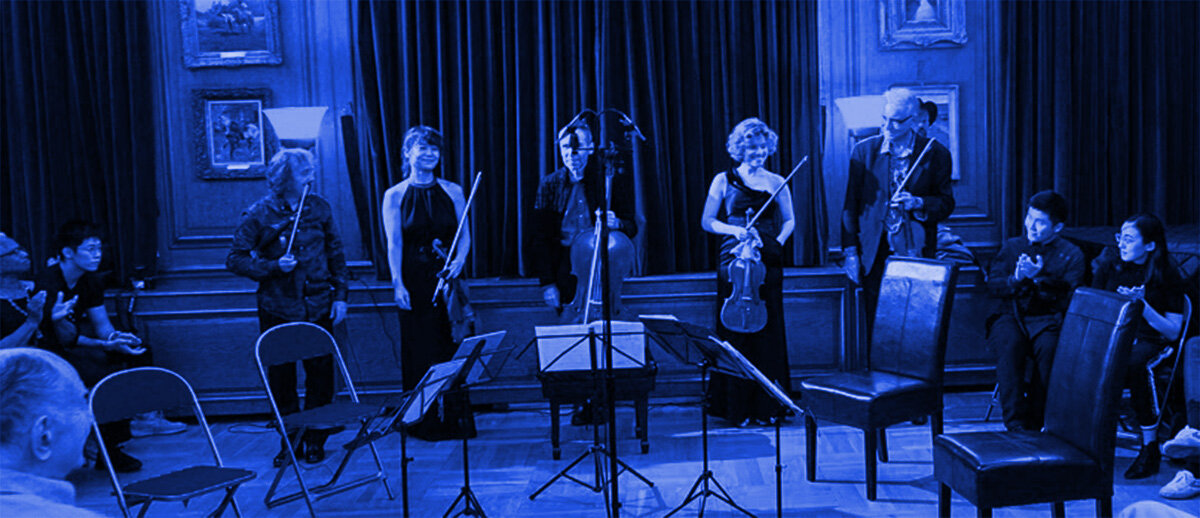
We need your help
Your contributions are essential to our mission of reaching more people with the extraordinary experience of live chamber music.
Thank you for making it happen.
OneMusic Project acknowledges the generous support of the following individuals for their time, gifts, and financial support. With their help, we are able to realize our mission of bringing great artists from Europe and the USA together to perform in our community.
Please join our partnership today by giving to OneMusic Project today!
OneMusic Project is grateful for support from
James & Susan Aisenberg
Veronique Brossier
Chu Family Foundation
Dan Kainen & Karen Dorst
Robert & Nina Kaufelt
Loube-Li Family
Philippe Muller
Alexander Ommaya
The Morris and Alma Schapiro Fund
Robert Spitzer
Richard Holley
Susanne & Frank Hugus
Wei Family
Joseph Towbin
Individual Contributors
Brian Loube
Ellen Oppenheim
Betsy Mulberry
Zoe Lo
Liza Loube
Ben Young
Eric Sandell
Jeff Vock